
Issue #88: Monday 16 March, 2026
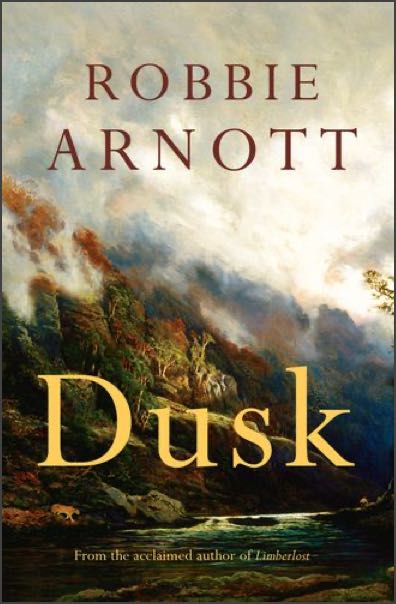
Superficially at least, this fourth novel by the author of The Rain Heron and Limberlost is a kind of Western, set towards the end of the 19th Century in... well, it is somewhere very like Tasmania. But I would argue that it is not the Tasmania we are familiar with, nor is its history exactly that of our own timeline. In almost all of Arnott’s books, there are gently fantastic elements which set us somewhere else, a Tasmania of the mind, a slightly twisted or shifted version of a part of the world which Arnott obviously loves dearly. I’ll give my reasons for applying that to this particular book, Dusk, later on.
The story focuses on a sister and brother, Iris and Floyd Renshaw, who are twin siblings and very close. They are both in their late 30s. The point of view throughout is almost entirely that of Iris. Her brother suffers terrible back pain from some injury. We don’t learn what happened to cause this injury until late in the book.
As the story begins, they are down on their luck and desperately looking for manual work of any kind. They have left the lowlands where they, and particularly their now-deceased parents, have developed a reputation as thieves and murderers, and come up into the highlands. Here they learn about a rich bounty being offered for anyone who can kill a wild puma, known as “Dusk”, which has been killing sheep. Dusk is the last surviving remnant of a group of pumas imported decades earlier to kill deer, whose population had been growing uncontrollably. Predictably, this attempt at ecological control went badly wrong and the pumas went after the much-easier-to-catch sheep instead. The pumas were progressively hunted down and now only one remains, a wily, ferocious beast who has already killed several of those hunting her.
Though they don’t even own a rifle, the twins decide to try for the bounty. I won’t go into detail, but of course inevitably they do indeed come into contact with the puma. On the way there is violence and betrayal aplenty, keeping you turning the pages.
That’s the basic story, but more than anything the book is about the relationship of the twins with each other. They have grown up in desperate circumstances, orphaned at a young age and forced to rely on each other to survive. That doesn’t mean that their relationship always runs smoothly, however, and Iris is frequently conflicted as she tries to find some happiness on her own.
Why do I say that the book is set in “a Tasmania of the mind”? Because there are some strange non-realistic features of the place. For a start, it is never referred to by that name, and there are significant differences: the story of the introduction of the pumas, for example; the fact that there are huge fossils poking up out of the landscape; a tavern surrounded by the ribs of some vast prehistoric creature; late in the book, a gigantic skull used as a shelter and refuge.
Most of all, we have a group of people seen as outcasts from European society, simply called by them “the peat-cutters” as that is how they make their living. Skin colour is never mentioned, but there’s clearly a connection made by the author between this group and Tasmania’s indigenous population. Iris comes in friendly contact with one of the peat-cutters called Lydia, who when talking to Iris makes frequent references to “your lot” and how they have treated Lydia’s people. It’s telling that Iris feels very drawn to the peat-cutters and dreams of joining them, and finds herself beginning to sympathise with Lydia’s positive attitude towards Dusk, a shift in attitude which has important consequences as the book draws to a close.
Highly recommended. If you haven’t read Arnott’s other books, you are really missing out. He’s certainly one of Australia’s greatest writers at the moment.
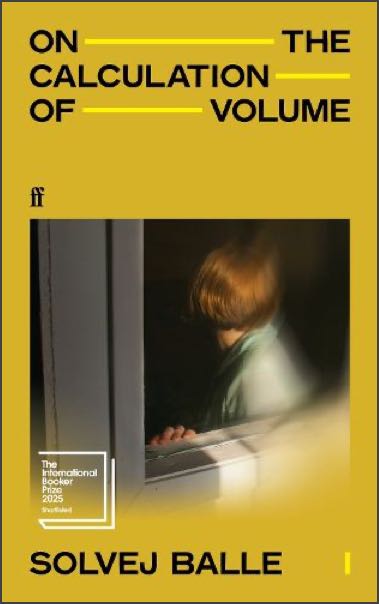
Time loops are a common but still very intriguing idea in speculative fiction. The movie Groundhog Day is probably the most familiar use of this concept. But that’s not to say that the idea can’t be looked at in a completely fresh way, which is what the Danish writer Solvej Balle appears to be doing here very successfully.
Interestingly, this novel is only the first of a projected seven volumes of the story, the last couple of volumes still to be written and of course yet to be translated from the Danish into English. If each volume is about the same length, then the final complete work looks like being around 1,200 pages in length, a huge tome if put into a single binding. I do have to say, though, that this first book could quite happily stand alone as an impressive novel in itself, even without the prospect of more to come. It was shortlisted for the International Booker Prize.
So the basic concept is that of Groundhog Day: a woman who has become stuck in time, reliving the same day, the 18th of November, over and over again. Unlike the Bill Murray character in the movie, however, she has more freedom of action, and as she discovers, her actions cause persistent changes in the world.
The book is told in the first person by Tara Selter, in her late thirties, who with her husband Thomas runs an antiquarian book service. They live in the small French village of Clairon-sous-Bois. On the 17th of November, as part of a buying expedition she travels to Paris where she will stay in a hotel for a few days before returning home. On the 18th of November she buys a few books and meets up with an old friend and ends up having dinner with him and his girlfriend, during which she accidentally burns her hand badly. She goes to bed with an ice-pack and a bandage wrapped around her hand. On the next day, which of course she expects to be the 19th of November, she wakes up with a still-painful hand and goes down to breakfast. It’s then that she starts to realise that something is wrong. Exactly the same incidents happen in the restaurant as had happened on the previous day. She checks the newspaper stand: the same headlines as she saw the day before. It’s still the 18th of November. And it stays the 18th of November on the following day.
Baffled and frightened, she eventually returns home to Clairon-sous-Bois and goes to her house. Thomas is surprised to see her, as he hadn’t expected her to come home so soon. She tells him the truth about her experience, and though startled, he quickly comes to believe her. They go to bed together, but the next morning Thomas is bewildered to find her beside him—she was in Paris. She explains again and again he believes her after a short period.
And so it goes. Each day she wakes up and has to explain to Thomas all over again and seek his help trying to break out of the loop, to no avail. Weeks pass this way, and Tara starts to notice that she’s depleting the stocks of their favourite grocery items in the small local supermarket. If she buys a can of fruit one day, it’s not there on her next visit.
As this volume ends, the anniversary of the first glitch it time (that is, 365 instances of the 18th of November which Tara has experienced) she has returned to Paris, hoping to use this recreation of her circumstances to break out of the loop.
This is beautifully if simply written (and well translated). Tara engages in some profound contemplation about what is happening to her and what it all means. I’m intrigued with where the author is going to go with this concept.
I haven’t yet picked up the second volume, though. Given that so far one volume has been completed each year since 2020, it’s tempting to hold off until the end of 2027 when presumably we’ll have the complete work available.
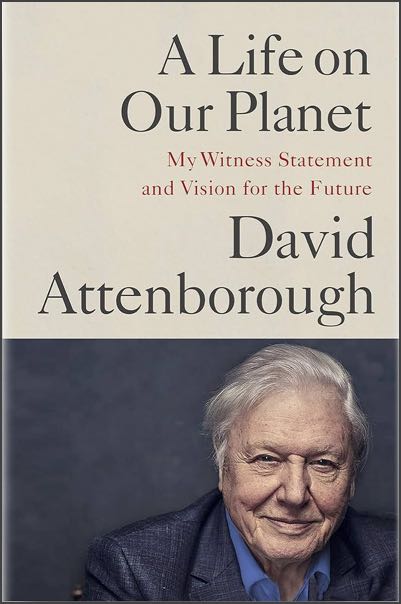
This is the book version of a documentary Attenborough made in 2020, drawing attention to the myriad problems we are causing to the one and only planet where we can live: destruction of wilderness, loss of biological diversity, climate change. It’s all very sobering; but Attenborough follows up with sensible suggestions as to how we get ourselves out of this mess. Whether those suggestions will be pursued is, of course, the important question.
“And that’s why Capitalism must be destroyed!” declaims my inner Cato the Elder.
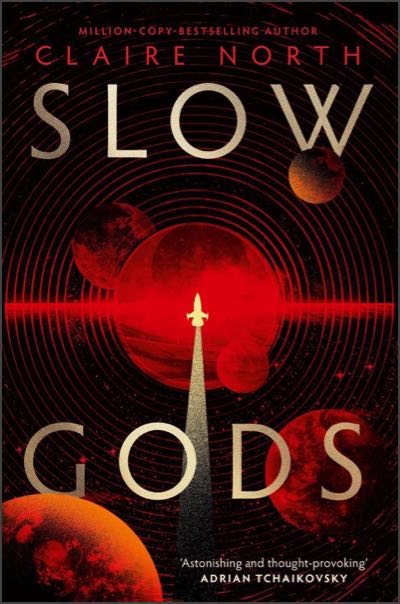
I won’t give my full review of this here, as we’ll be talking about it on our podcast in a few weeks. I will say this is a strange book with a very odd protagonist with a peculiar life (or death) story. I’m not sure that I like it, though I’m a big Claire North fan. I need to read the book for a second time, I think.
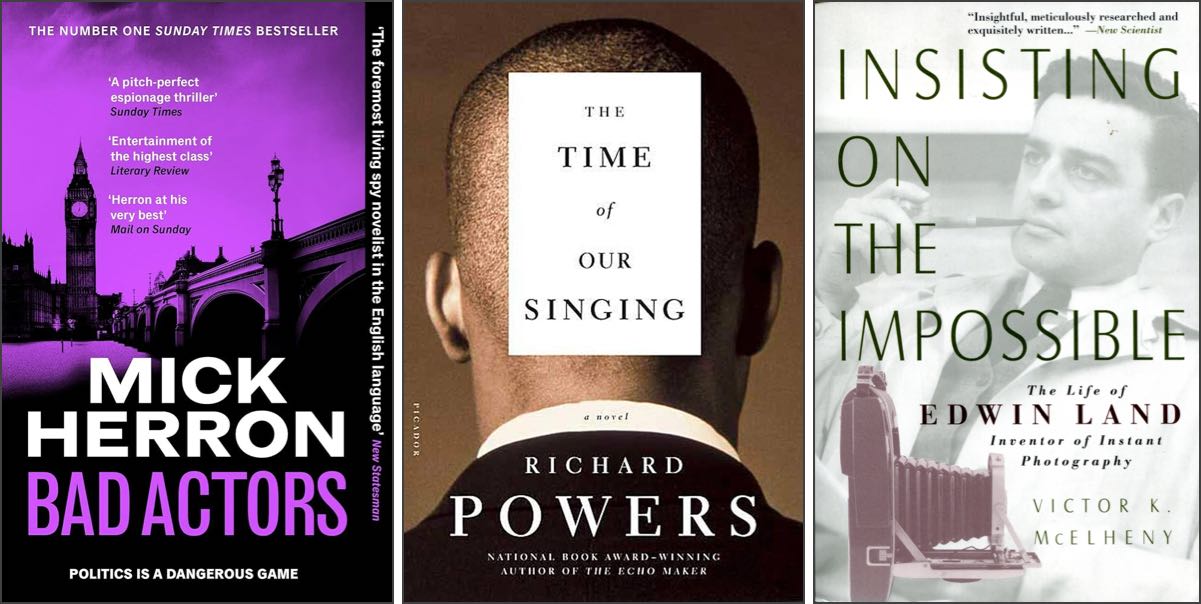

Pretty ho-hum continuation of the movie series following the original Jurassic Park. Scarlett Johansson does a good job, though, as a team ventures to yet another island used to re-create dinosaurs (and build some new ones). Pleasantly exciting in places, but nothing of any depth.
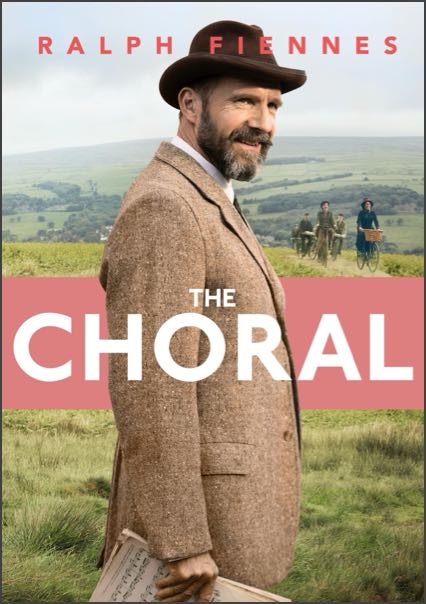
I went to see this as part of a fund-raising event set up by my community choir, and enjoyed it greatly. It’s written by Alan Bennett, a great British writer and screenwriter (you might have seen his semi-autobiographical film The Lady in the Van).
Ralph Fiennes was in good form, he’s so good in so many very varied roles. Here he’s Dr. Henry Guthrie, a conductor brought in to train a local choral society in a town in Yorkshire during the First World War. Anything German is anathema, so they have to drop their planned performance of the Bach St. Matthew’s Passion, which would have been sung in English, but it’s by a German composer, oh horrors! Similarly for anything by Mozart, Handel or Beethoven. Heaven forbid they should attempt Brahms’s German Requiem. Henry Guthrie eventually settles on the very English Edward Elgar and his oratorio The Dream of Gerontius. Except with their limited resources they need to cut it down and given the current circumstances, they decide to modify it.
There’s some wonderful music and choral performances, of course. But what got my immediate attention and interest is that it was all filmed in a town called Saltaire, where I used to live. “I know that mill!” I thought.
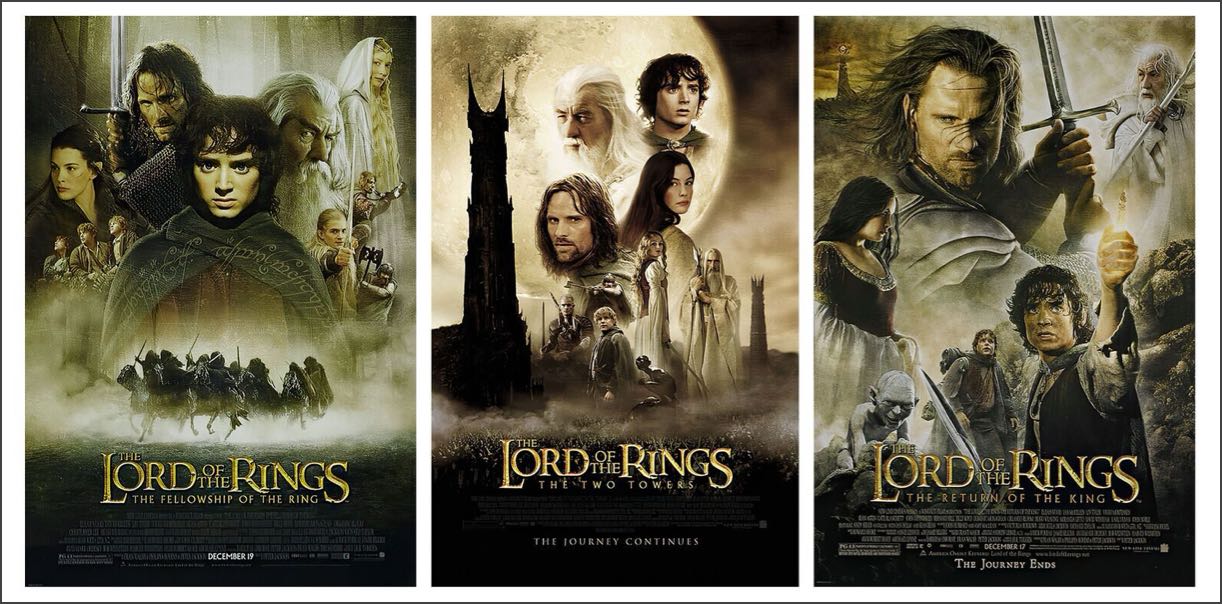
What can one say about this now-classic trilogy of films? By conincidence I started re-watching it just before my podcast co-host Perry listed them as part of his favourite films of 2025 in a recent episode. Though one can certainly criticise Peter Jackson’s approach on several fronts, it’s pretty clear that his version of the Tolkien books is as good a rendition as one could reasonably expect. Perhaps in future there will be another attempt, but it doesn’t seem very likely.
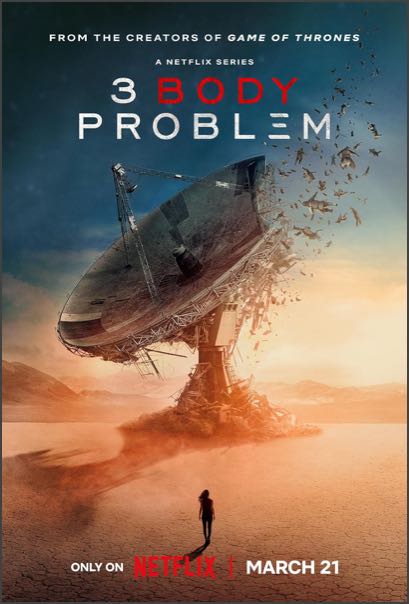
I’ve only read the first book of Cixin Liu’s trilogy Remembrance of Earth’s Past, but in any case this first season really only covers the first book and perhaps a little of the second.
This is a “first-contact” story, a contact which as it turns out was initiated by a young Chinese woman. The aliens contact Earth in an unusual way, however, using a video game to depict the problems of their system, which features two stars. With their planet as a third body, it is a 3-body system, which is unstable and chaotic, so the inhabitants of their world endure severe, rapid and to them unpredictable shifts of climate. Now that they are aware of Earth and its stable orbit... well, you can guess the rest.
It’s extremely well-done, produced by the same people who produced Game of Thrones. I’m looking forward to watching the second season.

I reviewed the first two seasons of this here, and this third season keeps up the high standard of interest, with the tension cranking up between Britain and the United States even further.

I watched the first season of this when it first came out, and enjoyed it a lot. Idris Elba is Sam Nelson, returning to the U.K. from Dubai on board a plane which is hijacked for reasons which at first are not clear. Nelson, a professional negotiator, tries to avoid disaster. Very tense and watchable (though—spoiler—I was a bit critical of the ending when a plane has a near-catastrophic crash and yet the passengers are able to disembark via a standard set of airport steps).
The second season has the protagonist of the first (Idris Elba) in what at first seems quite a different role. A train on the Berlin U-Bahn is taken over by hijackers. Seems at first like a replay of the first season, just with a train? Yeah, except that you quickly discover that Sam Nelson is himself the hijacker this time, for reasons it takes several episodes to discover.
Good stuff. I doubt that they could make a third season credible, though.
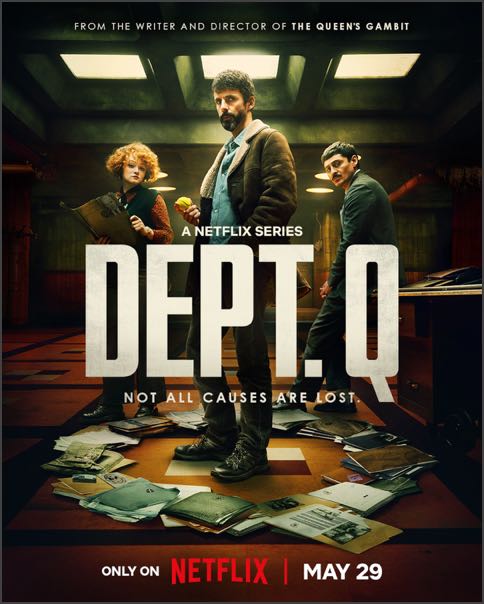
I was put onto this by my podcast co-host Perry. I can’t do better here that to quote here what he said about it in a recent episode:
This follows Detective Carl Morck, who returns to the Scottish Police Force. following a shooting in which he is badly injured, his partner is paralysed, and a young constable is killed. When he returns, he is relegated to the unsolved crime section on Level Q, which is way down in the basement. He assembles a bit of a motley crew, namely a woman who wants to get into a bit of detective work but is a bit pushy, and so people are quite happy for her to be shoveled off down into the basement. Also a mysterious character from the Middle East who seems to have had a background in the security, but he's actually moved into I.T. and is now trying to get himself a job in the Scottish Police Force, and so they move him down there as well to get him out of the way. He proves to be incredibly valuable to Carl Morck.
They are trying to solve the mysterious disappearance of a Scottish lawyer who went missing a few years previously, seen on a ferry from Scotland to one of the islands, and then just completely disappeared, didn't make it off the ferry. They don't know what's happened to her, don't know where she is, and so they work on trying to track this down.
Quite an excellent piece of work. It's based on a TV series out of Scandinavia, which I've got copies of on DVD but haven't watched yet.
I can recommend it, too, although the timing of the climax is a little too much on the co-incidental side for my taste, but I guess that’s drama for you.
If you’d like to make a modest contribution to my efforts in this newsletter, I’d love it if you would buy me a coffee.
Want to comment? Please send an email to:

© Copyright 2025 by David R. Grigg
and licensed under Creative Commons License CC BY-ND 4.0.