
Issue #86: Monday 16 February, 2026
I’m really getting back into my groove with reading now, I’ve completed eight books since last issue, some good, some bad, as you’ll see.
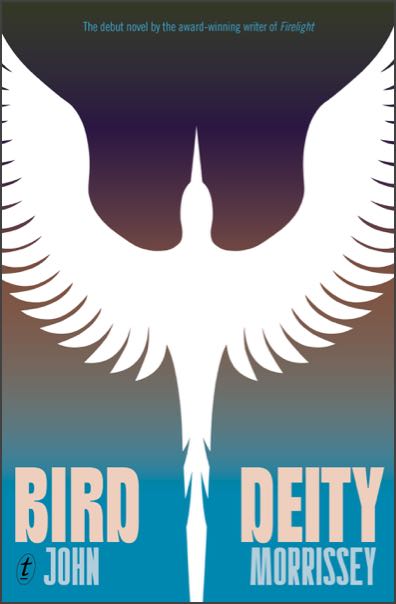
My thanks to Text Publishing for sending me a review copy of Bird Deity, the debut novel from Australian author John Morrissey. He has received considerable acclaim for his short story collection Firelight.
This is an intriguing, melancholy, down-beat work of fiction. It’s deeply puzzling in several ways, and so I read it twice, appreciating it more on the second read. I often do this for books which seize my imagination, and which I know I’m going to want to review, so please don’t think that you need to read it more than once to appreciate it.
The story is set on a unnamed planet being exploited by humans. There are mineral resources, huge trees to be logged, and an enormous high plateau on which semi-humanoid aliens live. Scouts regularly visit this plateau to look for the aliens, who they derisively call “ashies” for their ash-coloured skin, though their official name is parasape.1
It’s impossible to read the book, by an indigenous Australian writer, and not think of parallels with the British colonisation of this country, and their contemptuous and cruel treatment of the indigenous population, whose culture was tens of thousands of years old. But the book is much deeper and interesting than that superficial analogy.
The parasapes often wear attractive arm-bands, necklaces or other jewellery which are greatly prized on Earth. The Scouts simply steal these, taking them boldly from the arms or necks of the listless aliens, meeting no resistance. It’s clear from the intricacy of this jewellery that millennia ago the aliens must once have had a thriving civilization, but now are reduced to a kind of stupefied misery, barely able to feed themselves.
The novel is written from the omniscient point of view, but the focus is almost entirely on the character of David, one of the Scouts who has just completed a second five-year term on the planet and is about to return to Earth. He has amassed a great fortune by collecting parasape artefacts for the Association of Scouts. He can spend this money only when he returns to Earth, and currently lives a miserable existence in a hut. There is almost constant rain.
Tom, one of David’s few friends, has not returned from an expedition to the plateau several months ago. David has had a brief sexual relationship with Eliza, Tom’s wife, who now has a child which could well be David’s. She is desperate to return to Earth with her baby, but the authorities refuse to give her a berth, saying that it is reserved for Tom. She is becoming resigned to having to remain on the planet indefinitely. David feels guilty and sorry for her and the baby, but can’t bring himself to offer her his own berth on the frigate.
Then a woman arrives who seeks David out to take her up onto the plateau. She says she is an anthropologist comissioned by her trillionaire patron to learn about the culture of the parasapes. Though David has resigned from the Association of Scouts and is no longer permitted to visit the plateau, he takes her nonetheless. The pair spend weeks trying to locate groups of parasapes, without much success. There is some striking writing in the book, with many rich descriptions of the environment through which these characters traverse. They become separated, and David becomes ill, developing pneumonia, and from this point his experiences become somewhat illusory and dreamlike, culminating in something which might be an extraordinary vision or a paranormal experience.
We also occasionally have the viewpoint of one of the parasapes, an old individual apparently living at the time of the catastrophe which has destroyed the parasape civilisation, many thousands of years before the current day. This viewpoint, and the fascinating mythic background of the parasape culture, are key to understanding David’s experiences, and his ultimate decisions at the close of the book.
You are given no easy answers, but are left with many questions which will haunt you for quite a while after finishing the book.
Definitely recommended. I will be very interested to see what this young author does next.
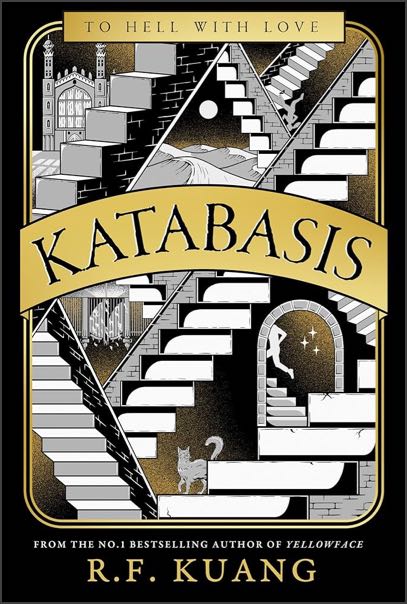
I found this very disappointing, since I had liked the author’s Babel, or the Necessity of Violence so much, and quite liked her Yellowface. So much so that I bought this book in a handsome hardcover edition, signed by the author. Alas, now I have buyer’s remorse.
The book begins in Cambridge University, where Alice Law and Peter Murdoch are doctoral students under the tutelage of Professor Jacob Grimes. Their subject? Magic, or as Kuang would have it “magick”, an affectation I found annoying throughout. Alice has made a mistake in drawing up a crucial pentagram, and thus accidentally killed Professor Grimes in a gruesome manner. Apparently only Grimes could pass Alice and Peter so they can get their doctorates and find employment, so Alice, after much research, draws up a special pentagram and chants the right words in order to descend, like Orpheus, into Hell itself to try to rescue Grimes, an unlikely Euridice. At the last moment, Peter Murdoch barges in and joins her in Hell.
A bit hokey, perhaps, but not a terrible concept for a fantasy novel. Alas, Kuang’s Hell turns out to be deeply uninteresting and there’s a lot of tedious marching across deserts of grey sand. There’s not much torment of souls to be seen, either, if you don’t count eternal boredom.
There are, I suppose, some worthwhile things the book says about power dynamics, misogny and racism in the academic world, but these gems are few and far between.
We do get some mildly interesting flash-backs of the lives of Alice and Peter and their relationship with each other and with Grimes. Constantly at odds with each other at the start, continuing the secret rivalry and mutual resentment they had as students, by the end of their journey (gosh, who could have predicted it?) they turn out to be in love. Awwww....
Will they find Grimes? Will they be able to escape from Hell and return to the ordinary world? The tension... well, it doesn’t mount, it just barely staggers upwards and falls asleep a couple of times on the way.
Sorry, I can’t recommend this.
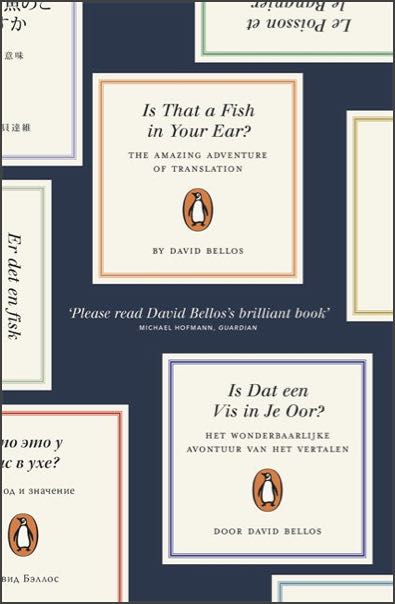
I’ve been reading this for months, just dipping in to read a chapter at a time. The whole process of language translation is far, far more complicated than you would think, and Bellos makes it all absolutely fascinating. He begins by analysing what we mean by translation in all its aspects, then moves, chapter by chapter to look at the challenges of translation in various domains: literary fiction, news reporting, multi-lingual institutions like the U.N. and E.U., even comic books. At each turn there is something surprising to learn. And it’s about language itself, not just the business of translation.
This is one of those rare non-fiction books which I’ll hang on to to re-read from time to time and frequently consult.
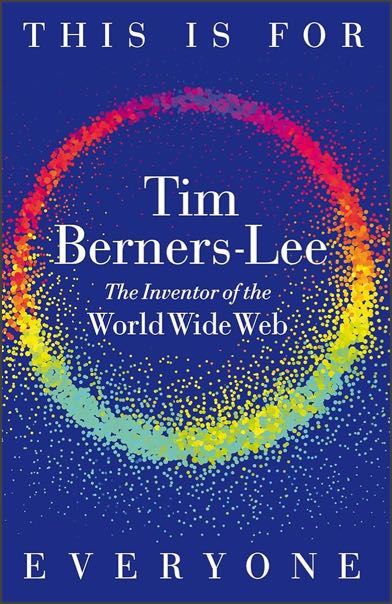
Very interesting autobiography of Tim Berners-Lee, who came up with the idea for the hyperlinked World Wide Web while working at the particle physics institution CERN in Switzerland. His story of how he came to that idea, and where it led him, is very engaging. It slows down a bit after that, but it’s nevertless interesting how Berners-Lee has continued to be a good godfather to the Internet, concerned with how it has been and is being abused, but confident that it can be guided back to the right track.
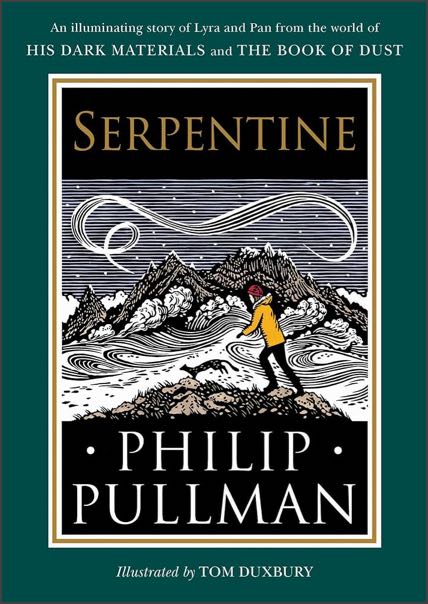
A very short book, extending Pullman’s His Dark Materials trilogy, and more importantly, giving the impetus to his second trilogy set in the same universe, The Book of Dust.
Lyra and her dæmon Pantalaimon head back to Trollesund, the Arctic town where she first met the aeronaut Lee Scoresby and the armored bear Iorek Byrnison in the first volume of His Dark Materials. They're on a mission to find the witch-consul Dr. Lanselius, hoping he can give them some answers about their ability to separate from each other.
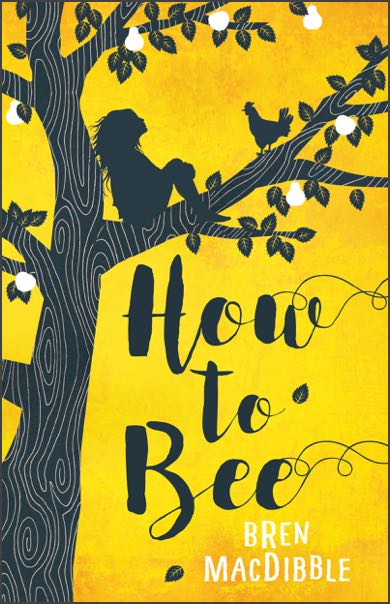
This is a terrific novel for middle-school-age kids, managing to deal with environmental change, domestic violence, neurodiversity and the inequality of society all in one engaging story. Peony is a ten-year old girl who is currently a Pest, hoping to qualify to become a Bee. No, she’s not an insect. Real bees have disappeared from the world because of pesticides and climate change, and young kids are being employed to fill in to keep fruit flowers become fertilised. When Peony’s mother abducts her from the farm and forces her to help her as a domestic servant in the city, her life changes dramatically for the worse. It’s only after she begins to help Esmeralda, the severely agoraphobic daughter of the family who owns the mansion where Peony has been forced to work that things begin to improve.
Many thanks to Lucy Sussex for recommending this one to me, I’ll go looking for other books by MacDibble.
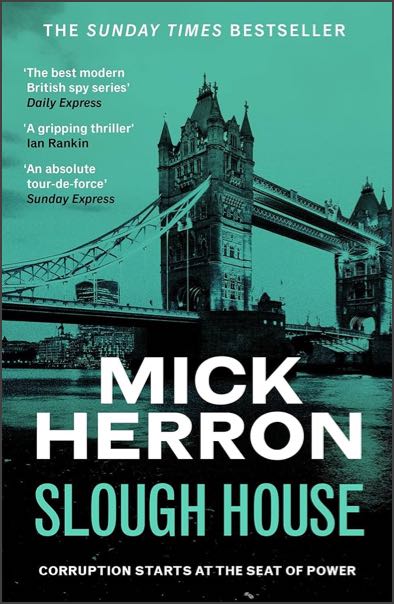
Another in Herron’s Slow Horses series. This is a particularly good one.
It seems that the agents of Slough House are being tracked and followed, and worse still, that some previous employees—and perhaps the current ones—have been targeted for assassination. Oh, and a bit of a spoiler: as ruthless as the killers are, Mick Herron is just as ruthless and doesn’t hold back from killing off his characters when the plot requires it.
Great stuff. I’ll be rolling on to the next book in series, Bad Actors, in the next few months.
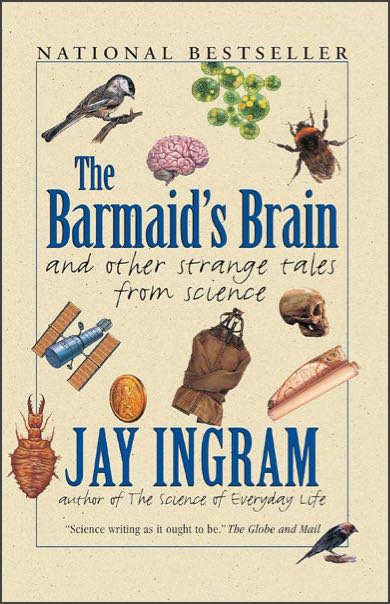
Entertaining bunch of stories about science, but I don’t have a lot to say about it. I picked up the book from Dick Jenssen’s collection, distributed by his executors Elaine Corcoran and Bruce Gillespie, along with several others.
Slowly tapering off my television watching in the evenings, but having resubscribed to Netflix in order to watch Frankenstein, I found rather a lot of movies and particularly TV shows that I wanted to see.
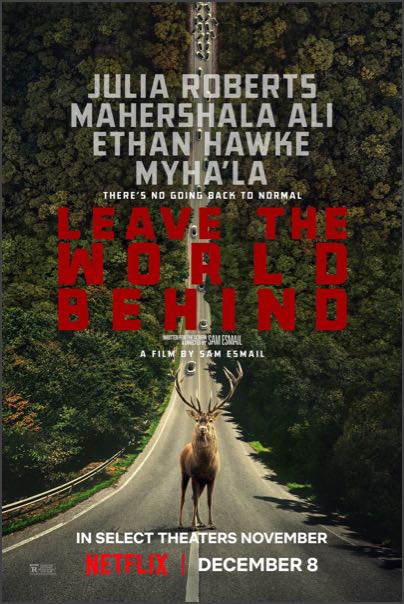
I didn’t much like this, though I can’t pin down exactly why. A White American family rent a home for a holiday. Some catastrophe happens, and the owners of the house, a Black man and his daughter turn up and ask to be let in. The wife in the holidaying family (Julia Roberts) initially reacts to this with alarm and great suspicion, and her not-so-subconcious racism is clearly behind that.
The catastrophe gets worse and worse, television stations go off the air, GPS no longer works, cities are burning, planes falling out of the sky, wild animals behaving in bizarre ways. Strangely, though, the house never loses power despite no reference that I caught ever being made to a generator. There’s much shifting of interpersonal relationships.
The film ends with what seems to me just a limp joke to do with the Friends television show.
The best part of the film was the scene where Tesla self-driving cars race along and crash into a traffic jam of... Tesla self-driving cars.
I actually went to see this in a cinema! I don’t do that very often these days. It was worth the inconvenience.
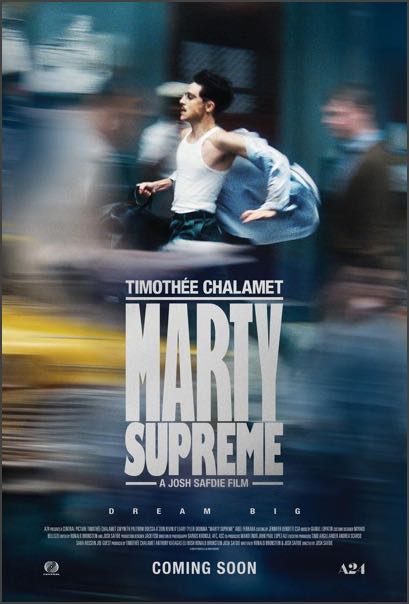
I really liked the film, even though the main character Marty, played brilliantly by Timothée Chalamet, is in many ways a very unlikeable character who causes great damage to those around him. He causes that damage by bulldozing ahead with his obsession to win the World Table Tennis Championship. The film is set in the 1950s, with much of the action in the grittier run-down parts of New York. Marty’s talent, other than being a whizz at table tennis, are in his total self-confidence and assurance that he is right in what he does. His crash-through-or-crash approach is fascinating to watch even if often you are wincing at the pain he causes.
Gwyneth Paltrow is also very good in this as the aging actress who Marty manages to seduce (all with an ulterior motive in mind, of course).
Recommended.
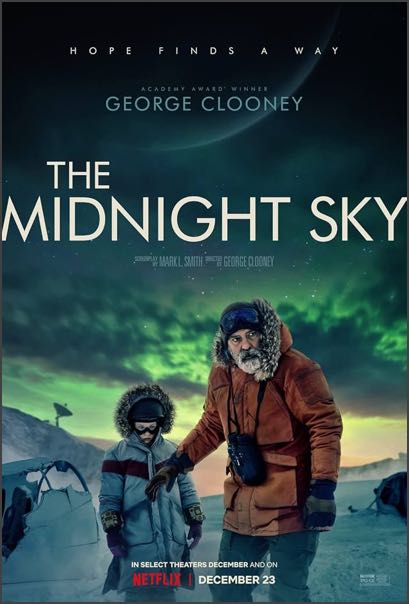
George Clooney both directed this and plays the main character, a scientist left alone in a polar research base when an apocalypse destroys the rest of the world, then to his astonishment finds that a young girl has been left behind. I didn’t like it much, there’s a lot of science-fictional nonsense and the “surprise” ending was utterly predictable.
Give it a miss.
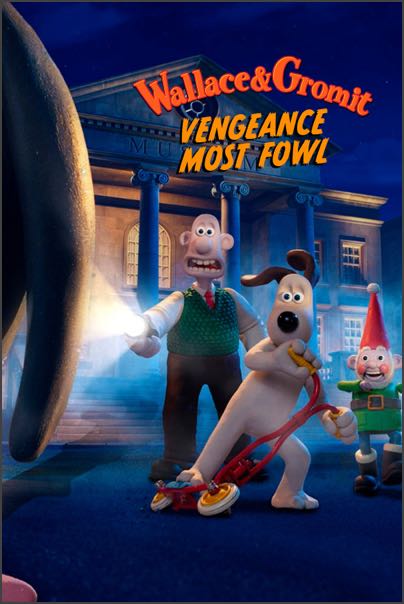
Not quite as much fun as the earlier Wallace & Gromit films, but enjoyable enough, I guess. The evil penguin Feathers McGraw, the villain in The Wrong Trousers escapes and seeks vengeance on our hapless pair. Gromit, Wallace’s dog, again saves the day.
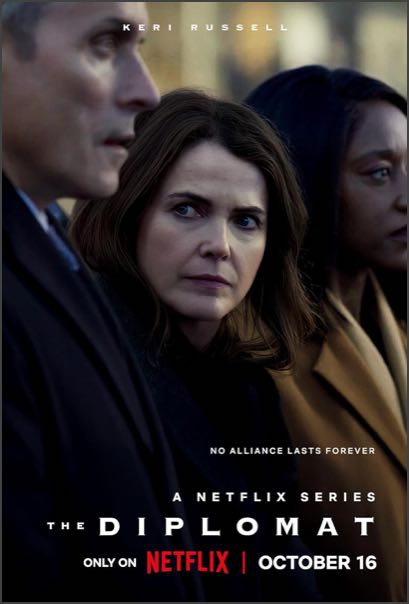
Very engaging series about Kate Wyler (Keri Russell), a diplomat appointed, rather against her wishes, to be the American Ambassador to the United Kingdom. One major complication is her ex-Ambassador husband Hal (Rufus Sewell) who tries to insert himself into every negotiation, or else is drawn in to such negotations by people who know him.
The first two seasons revolve around an incident where a British warship was attacked in the Persian Gulf, and more than 40 sailors killed. Initial thinking is that it was done by Iran, or Iranian-backed terrorists. Turns out the true story is much more complex than that.
Both Russell and Sewell are excellent in this, as is Rory Kinnear as the beligerent British PM and David Gyasi as the British Foreign Minister with whom Russell becomes involved.
Good stuff, I’m part way into the third season now.
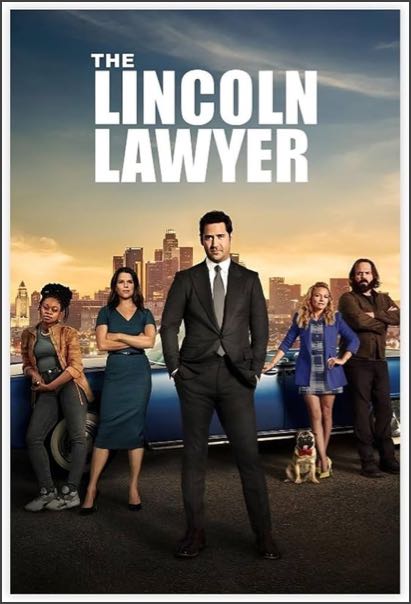
Enjoyable series based on the novels by Michael Connelly, who also wrote a heap of Bosch novels similarly set in L.A. Lots of entertaining courtroom drama and manouverings to find evidence.
I’m partway through the second season. The fourth season has just been released, so plenty more watching to come.
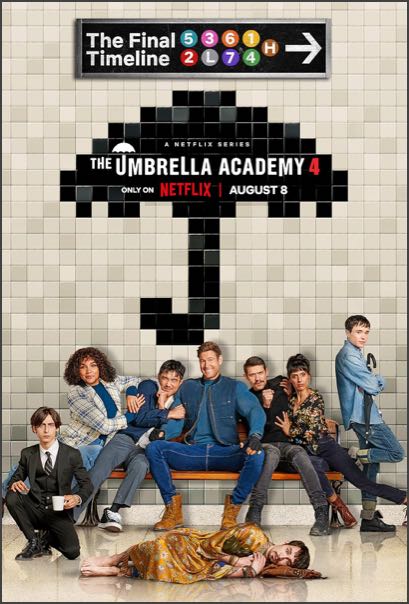
Quirky superhero series which is very far removed from the DC and Marvel superhero universes, and all the better for it. It’s based on material from Dark Horse Comics. A highly disfunctional family of varied talents need to save the world. Again and again.
My favourite character is Aidan Gallagher as “Number Five”, who returns from the future as a adolescent boy in Season 1, and who is the sassiest and smartest of them all. Gallagher was only 15 when he started in the series, yet does an amazing job, dominating almost every scene he is in. Elliot Page is also terrific in Season 1 as Vanya, the one child in the family who is apparently not special in any way (but wait for it...), and then as Viktor from Season 3 onwards. Really, every character is good, though they are very different from each other.
There’s a lot of sour comedy as the family members bicker with each other and make snide comments. Oh, and lots and lots of violence, though it’s rarely gory or distressing.
Loved it. There won’t be any more seasons, though.
Comment on comments: it’s quite tricky knowing how to deal with emails of comment to an online newsletter. Should I include comments in one issue which deal with previous issues? Or place those comments at the end of the issue the email discusses? Or maybe start with publishing them as soon as I get them, and later move them to the issue they reference? Don’t know. Hence the following series of emails from Mark Nelson, covering several past issues.
From: Mark Nelson
Date: 16 January 2026
Mark:
There were a large number of comments in Biblioscope 82 which resonated with me and I started to write a loc before we went on our summer holidays... I should have found the time to continue writing it whilst we were away, but writing locs wasn't high on the agenda. Then when I returned I had other things to occupy my time, such as finishing my contribution for the next ANZAPA. Here's what I wrote...hope it's of some interest.
Earlier in the year I was asked to review a book by Bloomsbury. In the past I've been asked to review a book proposal. This time was slightly different, I was asked to review one of their current books. I was given the choice of being paid a small amount (USD $100) or receiving slightly more (USD $200) in books. Would it surprise you to learn that I took the latter? I was able to find eleven books of interest. These included two novels by Adrian Tchaikovsky: Cage of Souls and City of Last Chances. I have not read these yet. There are various reasons for this, including moving house last year. But one reason is that the number of unread books in my main collection of unread books has now reached seventy. In theory this means that I won't be buying any additional books until... well, not until I've reduced that number down to zero unread books. That is unrealistic. But at least to more manageable levels. Perhaps I'll allow myself to buy one new book for every two books that I read.
Your review of Cage of Souls was therefore of interest to me. No, that's not quite right. Your reviews are always of interest. Perhaps I should say that it's of more interest. Or it's of particular interest. Anyhow, it's good to know that I made a sound choice in selecting this novel. I've not previously read any of Tchaikovsky's novels, so I am looking forward to the two I selected.
With the exception of Thomas Mann's Buddenbrooks, an 18th birthday present from my dad, I've always finished every novel that I've started. (I need to go back to Buddenbrooks and give it another shot. Thirty-nine years later I may make more of it.) Having said that, I have recently decided that I don't need to finish every book that I start. If I'm finding it hard going there's no shame in not finishing it. Which is a round about way of saying that in your situation I might not have finished reading The Saint of Bright Doors — podcast be blast!
When I arrived in Australia, in May 2000, I decided to read the winners of the Miles Franklin Award. That decision didn't come out of the blue. I'd already read George Johnston's My Brother Jack (winner in 1964) and Tim Winton's Cloudstreet (1992). I mentioned this at work to a colleague, who had in fact introduced me to the two winners I'd already read. He replied that this was an easy task as I could borrow the winners from the library. However, that wasn't the tack that I decided to take. I wanted to own them. I'm not sure why I wanted to do this. If I moved back to the UK after my temporary appointment had run its course (three years), would I have paid to ship back a stack of books? I doubt it. It took me until 2016 to track down every winner. At that point I decided to switch to reading winners of the Booker Prize. One difference between winners of the Booker Prize and winners of the Miles Franklin is that the former are all in print, whereas many winners of the latter are out-of-print. A reflection on the relative size of the markets for the prizes. This means that, as a last resort, I've been able to order new copies of any Booker Prize winners that I've been unable to track down, rather than ordering a second-order copy from places such as abe.com.
That's all I had time to write.
From: Mark Nelson
Date: 26 January 2026
Mark:
I mentioned in my last loc that I was paid USD $200 (excluding postage) in books by Bloomsbury for reviewing one of their engineering mathematics textbooks. You have reviewed another one of the titles that I selected: The Watchmaker of Filigree Street. As before, I have not yet read this. However, since I started writing my loc on issue 82 I have read one of the eleven books that I selected: The Best of World SF Volume 1. I imagine that I will go on to read volumes 2 and 3 before reading the other titles that I ordered.
I haven't read very much crime fiction, besides Inspector Morse. It's not that I have anything against the genre, it's just that I have enough to read as is. I haven't read any of the winners of the Ned Kelly Award, I think the only Australian crime novel I've read is Peter Temple's Truth which was the winner of the Miles Franklin Award in 2010. I really enjoyed that and I intended to read more of his novels. I did like the sound of one of the books that Perry mentioned in Two Chairs in Print 12, Fiona McFarlane's Highway 13. I'm putting that on my wish list of books.
I know the name, I've heard of Wilkie Collins. But I've never read any of "his" novels. I write "his" because before I read your blurb for The Haunted Hotel I always assumed that Wilkie Collins was a she. That may mean that I didn't read very carefully any of the articles that result in "his" name floating around in my memory.
David:
His full name was William Wilkie Collins.
Mark:
Although I'm reading the winners of the Booker Prize, I have not paid any attention to the winners of the International Booker Prize. That may be because I'm a typical colloquial Englishman, though I prefer to think that it's just that there are too many interesting books to read and you have to have some way of filtering them. Having said this... I went into an independent bookshop in Sydney last year and saw that they had displayed the nominees for the International Booker Prize. As I was walking past them I notice that one of the nominees was entitled On the Calculation of Volume. I could hardly let that title go by. So I picked it up, flicked through it, and decided to add it to the pile of books that I was buying. I haven't read it yet... so I am looking forward to reading your review to see if I picked a good one.
Using integration to calculate the volume of objects is a standard topic in first-year calculus. Despite teaching at Wollongong for twenty-one years I only taught this topic once. Overall, I don't think it's productive to think what might have been... but I wish that I had been more worldly wise as to how teaching allocations were made.
Although I did not grow up in the 1960s, I am a Beatles fan. You couldn't grow up in the 1970s in the UK and escape being exposed to their music. (Is that last sentence true for all decades since the 1960s?). The only Beatles album that I own is "Sgt. Pepper", though I did burn my parents’ two CD set which collected all their best songs. I really [liked] Yesterday, which I watched on an aeroplane. We do have the DVD, but I haven't found time to watch it. In fact, although we moved at the end of May 2025 Sianne still hasn't got around to connecting the DVD player to the TV...
As I remember it, Jack was playing Beatles songs in the "real world" before he woke up in the alternative world where they never existed. I think it's plausible that a good musician, who has a good memory and familiarity with the Beatles, would be able to recreate some of their numbers. At the end of the movie he discovers that it's not only the Beatles that are missing in this world, the Harry Potter novels also do not exist. MY question is, would he be able to recreate the Harry Potter novels with the same degree of success that he recreated the music of the Beatles? I've read Harry Potter and the Philosopher's Stone a few times, and the second through to fourth novels twice. The others I've read only once. I've seen all the movies a few times. I'm not sure that I could summarise in detail all the novels, except perhaps the first. But to rewrite the Potter novels Jack would have to, well, rewrite the Potter novels. Could he do that in an appealing authorial voice? Clearly, it would not be enough to reproduce the plots to find a publisher. After all, the first Harry Potter novel was rejected twelve times before it was picked up by, of all people... Bloomsbury. And there we have a connection to my first paragraph, so it is time to stop.
David:
I doubt that Jack, or anyone else would be able to reproduce the entirety of a modern novel unless they had a photographic memory. I do remember however that scene towards the end of Farenheit 451 where people are attempting to memorise great works of literature by reciting them aloud, so maybe it would be possible with shorter works at least.
From: Mark Nelson
Date: 1 February 2026
Mark:
I enjoyed reading your various "Best" lists for 2025. But then I've always enjoyed reading lists. Your collection of pie charts was also of interest, as well as your ending analysis on the page length of the books that you had read. You didn't give an average value, but the mode and median was clearly the 301-400 page range.
Why did you decide to read Mrs Dalloway? I assume that you provided your reasons when you reviewed it in Biblioscope. But if you did, I don't remember what they were. I mention this because I reread Mrs Dalloway last year. In my case it was because I heard mentioned on the BBC World Service that 2025 was the centenary of its publication — this was sufficient reason for me to track down a second-hand copy. Now I'm wondering if there were any good novels published in 1926 that I should consider reading in 2026. I'm sure that ChatGPT would offer me some suggestions if I asked.
David:
I read Mrs Dalloway specifically because I had bought a two-book package from Readings of novels by the Australian writer Miranda Darling, one of which (Thunderhead) was clearly a modern take on Mrs Dalloway, and since I hadn’t read that yet, felt I needed to. I’m glad I did.
Books from 1926? Check out Standard Ebooks. We have lots of books which are now in the public domain, and currently anything published before 1930 is in the public domain in the U.S.A. (where S.E. is based).
Mark:
The other book that I've read in your top 10 was The Tusks of Extinction. This was prominently displayed in my local library, but picking it up I wasn't excited by the description of the story. I picked it up, then I put it back down again. But after reading what you and Perry had to say about it I decided to read it and I'm glad that I did. I wish there were more novels of a similar page length to this! Perhaps if I have some spare time at the library I will examine the SF bookcases for slim volumes.
How far back to your annual summary of books go? Have you thought about collecting them together? Perhaps ten years worth? That may or may not prompt some recollection by you as to how your reading has changed, or has not changed, over the period in question.
PS: ChatGPT puts forward the following novels that are 100 years of age in 2026
Earnest Hemingway, The Sun Also Rises. Franz Kafka, The Castle. A. A. Milne, Winnie-The-Pooh. Agartha Christie, The Murder of Roger Ackroyd. William Faulkner, Soldiers' Pay.
I've read none of these... but I will have to at least read Winnie-The-Pooh, one of Sianne's favourite characters.
David:
Thanks, Mark.
If you’d like to make a modest contribution to my efforts in this newsletter, I’d love it if you would buy me a coffee.
Want to comment? Please send an email to:

© Copyright 2025 by David R. Grigg
and licensed under Creative Commons License CC BY-ND 4.0.